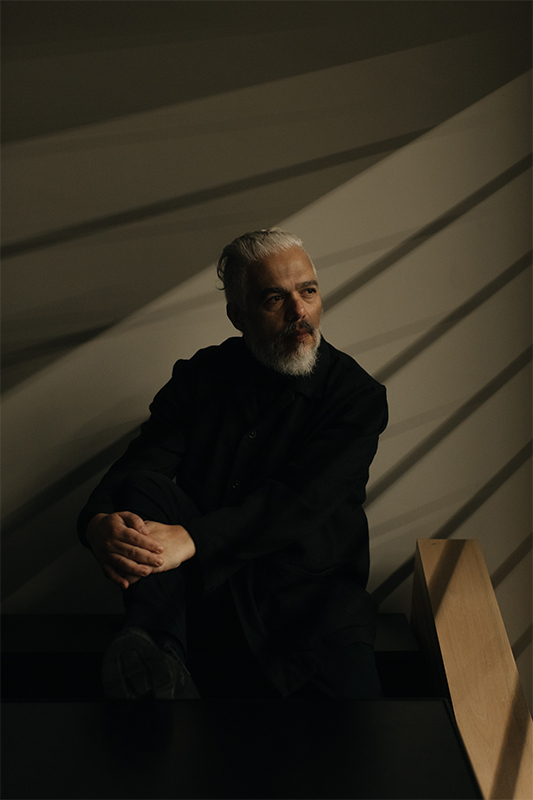
For BackTheBrush Studio Notes, we asked Héctor Esrawe how original art changes interiors, hospitality spaces, and public environments. His answers return to authorship, memory, local context, and the moment when art becomes part of spatial experience rather than a finishing gesture.
When art is approached merely as decoration, it tends to occupy a surface.
What makes an artwork feel born for a space?
An artwork feels native to a space when it emerges from the same questions that shaped the space itself, rather than being introduced as a final gesture or decorative element. Most of the time, it does not need to mimic the material palette or formal language of the project, but it should participate in, and potentially amplify, the conversation that the space is already having.
The most successful integrations happen when architecture, interior design, landscape, light, and art are considered simultaneously. In those cases, the artwork becomes a layer of the narrative in its own right, helping reveal qualities that may already exist within a place but have not yet been articulated.
When art is approached merely as decoration, it tends to occupy a surface. When it is conceived as part of the spatial experience, it can shape atmosphere, perception, memory, and even the way a person moves through a space.
Where does original art matter more than people realize?
Original art matters in almost every environment, but perhaps especially in hospitality and public spaces. These are places that aspire to create memorable experiences, yet many still rely on familiar formulas and generic aesthetics.
Original art introduces a layer of unpredictability, humanity, and authorship. It reminds us that a place is not simply a product but a cultural expression. In hospitality, art can become a bridge between visitors and the local context, connecting them to the histories, materials, narratives, and creative voices of a region.
What people often underestimate is that art does not only enrich a space visually; it gives it emotional depth. It creates moments of pause, curiosity, and interpretation, allowing a place to remain present in memory long after a visit has ended.
When can personal work become powerful in public space?
The challenge is not whether a work is personal, but whether the personal can resonate beyond both the individual who commissioned it and the artist who created it.
Many of the most meaningful works originate from deeply personal stories, memories, or observations. What makes them powerful is their ability to translate those intimate experiences into something others can recognize and connect with through their own lens, something capable of becoming collective.
In hospitality or public environments, the most successful commissions balance specificity and openness. They are rooted in a particular narrative, yet leave enough space for interpretation. When a work becomes overly literal, it can exclude the viewer. When it retains a degree of ambiguity, it invites participation.
The goal is not to tell people what to feel, but to create and enhance the conditions for feeling.
What should a client understand before commissioning a living artist?
The most important thing to understand is that commissioning an artist is not the same as procuring an object.
A living artist brings a point of view, a body of research, a methodology, and often a set of questions rather than predetermined answers. The value of the commission lies precisely in that perspective.
The most rewarding collaborations occur when there is mutual trust and enough room for dialogue. Clients should share their aspirations, context, and constraints, but they should also allow the artist the freedom to contribute something unexpected. If every outcome is predetermined from the beginning, the opportunity for discovery is lost.
There should always be an element of surprise and the possibility of going deeper into the conversation. It is often in those moments that assumptions are challenged and paradigms begin to shift.
Art has the capacity to elevate a project beyond functionality and aesthetics. It can introduce cultural relevance, emotional resonance, and a sense of authenticity that cannot be improvised or manufactured. Commissioning a living artist is ultimately an invitation to create something that could not have existed otherwise.
Esrawe's answers point to a quieter but more demanding version of patronage: not using art to complete a room, but inviting an artist into the set of questions that made the room worth making. In that frame, original work is not a decorative signal. It is a way for a place to hold memory, authorship, and the possibility of surprise.
This interview is based on an email exchange; answers have been lightly formatted for length and flow without changing meaning.